Once we understood airline alliances, we thought the system was starting to make sense. Then we discovered the partnerships outside them.
Some airlines partner with carriers in completely different alliances. Others work with airlines that aren’t part of a major alliance at all. And then there are loyalty ecosystems such as Avios, where the relationship goes even further.
This is where points and miles get more interesting, because knowing an airline’s alliance doesn’t always tell you the whole story.
⭐ Strategic Takeaway
Airlines don’t have to belong to the same alliance to work together. Direct partnerships can give a loyalty program access to airlines well beyond its alliance network.
Alliances and Partnerships Are Not the Same Thing
In our first article on airline alliances, we looked at Star Alliance, oneworld and SkyTeam. Those three networks give us a useful starting point for understanding which airlines are connected.
But airlines don’t limit themselves to their alliances. They can also form direct relationships with other carriers, including airlines from another alliance or airlines that don’t belong to one at all.
Depending on the partnership, you may be able to earn points or miles, redeem them for flights or access other benefits. The exact rules vary, which is why we don’t assume that two airlines work together in every possible way simply because they are partners.
The important idea is simple: the network available through a loyalty program can be much larger than the airline’s alliance alone.
One Example: Atmos Rewards
Alaska Airlines and Hawaiian Airlines are part of oneworld, so Atmos Rewards gives members access to the oneworld network. But its airline relationships don’t stop there.
Atmos Rewards also has partners outside oneworld, including Aer Lingus, Air Tahiti Nui, Condor, Hainan Airlines, Icelandair, Korean Air, Philippine Airlines and STARLUX Airlines.
So if you looked only at the oneworld member list, you wouldn’t see the complete network available through Atmos Rewards.
Why this matters
When you’re evaluating a loyalty program, don’t stop at the alliance. Look at its direct airline partners too. That’s where you may find additional ways to earn or use your points and miles.
Aeroplan Goes Well Beyond Star Alliance
Aeroplan is another good example, and one we use ourselves.
Air Canada is a founding member of Star Alliance, which already gives Aeroplan members access to a large global airline network. But Aeroplan also works with many airlines outside Star Alliance.
Air Canada currently says Aeroplan has partnerships with more than 50 airlines around the world. That means looking only at Star Alliance would give you an incomplete picture of what Aeroplan can potentially offer.
Its additional airline relationships include carriers such as Emirates, Etihad Airways, Air Mauritius, Azul, Gulf Air, Oman Air and Virgin Australia.
This is one of the reasons we find Aeroplan useful. We don’t think of it simply as a way to fly Air Canada. We look at the much larger group of airlines we may be able to access with Aeroplan points.
⭐ Strategic Tip
Don’t judge a loyalty program only by its home airline. The alliance and direct partner network can be much more important than how often you actually fly that airline.
Then There Is Avios
Avios works a little differently because the same loyalty currency is used across several programs.
Those include British Airways Club, Iberia Club, Qatar Airways Privilege Club, Finnair Plus, Aer Lingus AerClub, Vueling Club and Loganair Loyalty. Eligible linked accounts can move Avios between participating programs, giving you another kind of flexibility beyond a traditional airline partnership.
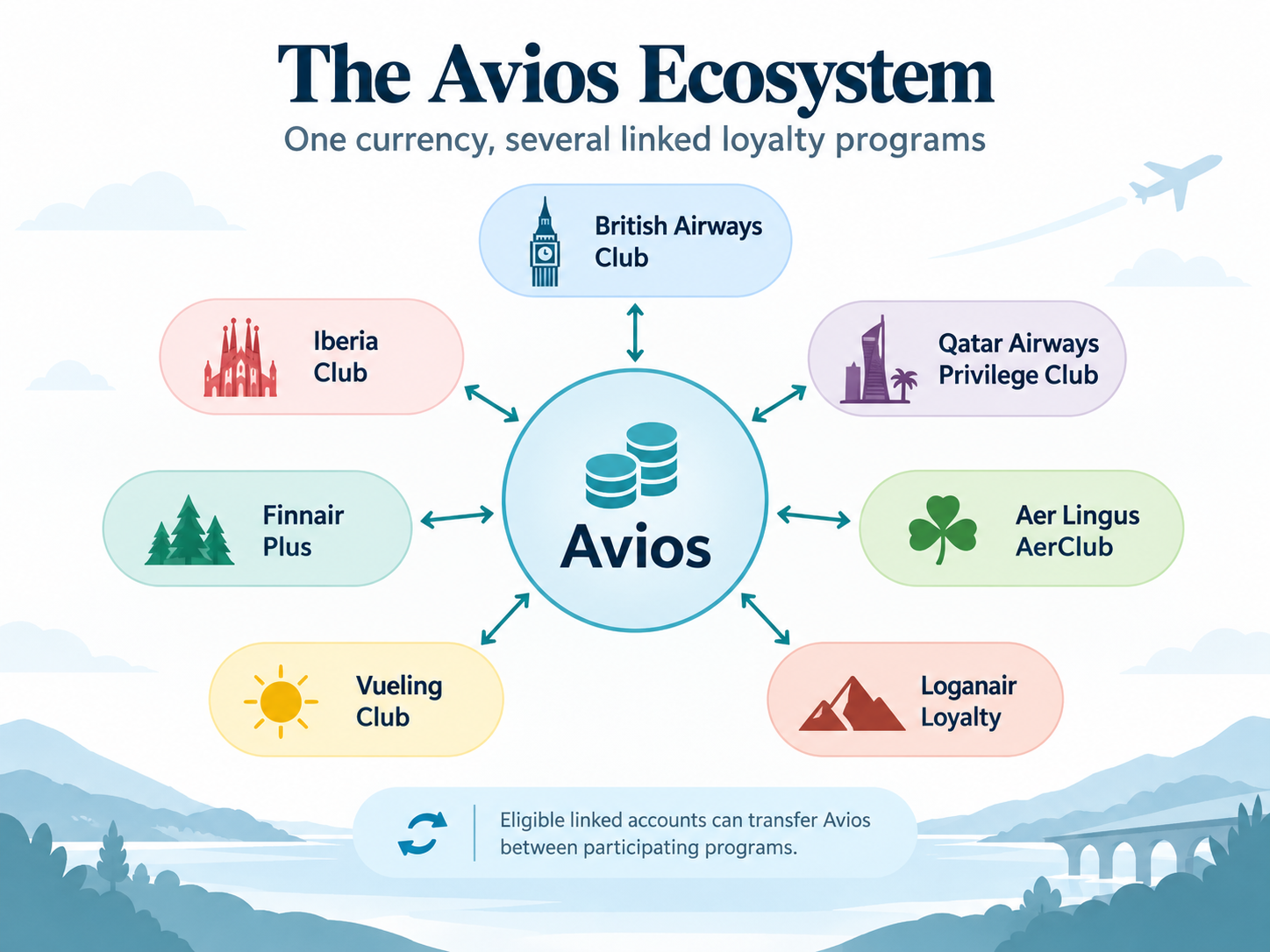
You don’t need to memorize every program in the graphic. The important idea is that Avios aren’t necessarily locked into the program where you first earned or received them.
Why Would You Move Avios?
Let’s say you have Avios in your British Airways Club account. You find a flight you want, but another Avios program gives you a better way to book it.
If the programs are eligible and your accounts are properly linked, you may be able to move the Avios rather than starting from zero in another program.
So instead of thinking, “These are my British Airways points,” we think of them as Avios and then ask which participating program makes the most sense for the trip we’re trying to book.
That’s a small change in how you think about the currency, but it can give you considerably more flexibility.
Partnership Doesn’t Mean Everything Is Interchangeable
This is where we need to add an important caution. Seeing the word “partner” doesn’t mean every benefit works in both directions or every flight can automatically be booked using either loyalty program.
The rules can vary based on:
- earning points or miles
- redeeming points or miles
- eligible routes
- fare classes
- award availability
- elite benefits
- taxes and fees
- how or where the flight was booked
This is why we always check the current rules of the loyalty program we’re considering rather than assuming that every airline partnership works the same way.
⭐ Strategic Tip
Never assume that “partner airline” means every flight qualifies. Check the current earning and redemption rules before transferring points and miles or making a booking.
How We Actually Search for Award Flights
This is where all of this becomes practical. We don’t start by choosing an airline or loyalty program. We start by looking at which routes are actually available between the places we want to travel.
Once we know which airlines operate those routes, we can investigate how those airlines are connected. Are they part of an alliance? Do they have direct airline partnerships? Which loyalty programs can potentially book the flight?
Only then do we start comparing our options.
So our process is really: find the route first, identify the airlines that fly it, then figure out which alliance, partnership or loyalty program gives us the best way to book it.
This is much more useful than starting with a pile of points and miles and asking where they can take us. We prefer to start with where we actually want to go and work backwards from there.
Why Partnerships Matter in That Process
Imagine you’ve found the route you want and identified the airline operating it. Your next step isn’t necessarily to open that airline’s own loyalty program and book there.
The flight might also be available through:
- another loyalty program within the same alliance
- a direct airline partner outside the alliance
- a connected loyalty ecosystem such as Avios
Those options may require different amounts of points or miles, and they can also have different taxes, fees, award availability and booking rules.
That’s why understanding partnerships matters. They give us more places to look once we’ve identified the flight or route we actually want.
How We Think About Airline Partnerships
We think about this in layers. First comes the route. Then the airline operating that route. After that, we look at the relationships around that airline.
Which alliance does it belong to? Which airlines or loyalty programs partner with it outside the alliance? Is there a shared currency such as Avios involved?
We don’t need to memorize every partnership in advance. We just need to know that these relationships exist so we know where to investigate once we find a route we’re interested in.
That makes the system feel much more manageable.
When Partnerships Become Especially Useful
Partnerships become particularly useful when you travel internationally, don’t always fly the same airline or want flexibility in how you use your points and miles.
That describes the way we travel. We aren’t trying to organize our trips around one airline simply because we happen to have its loyalty account. We want to know which airlines can get us where we’re going and then determine how our points and miles can help us book those flights.
Sometimes the answer comes from an alliance. Sometimes it’s a direct airline partnership. And sometimes a loyalty ecosystem such as Avios gives us another option entirely.
Our Take
Airline alliances gave us the framework. Airline partnerships showed us why we shouldn’t stop there.
Once we understood that a loyalty program could provide access to alliance airlines, direct partners and sometimes a broader ecosystem such as Avios, we stopped evaluating programs based only on the airline whose name was attached to the account.
More importantly, we stopped starting with the loyalty program altogether.
We start with the trip we want to make. We look at the routes and airlines available to us, and then we investigate the alliances, partnerships and loyalty programs that might help us book them.
For us, that’s a much more practical way to use points and miles.
The Bottom Line
Star Alliance, oneworld and SkyTeam are important, but they’re only one layer of the airline loyalty system.
Direct partnerships can give a loyalty program access to airlines outside its alliance, while ecosystems such as Avios add another layer of flexibility between participating programs.
You don’t need to memorize all of these relationships. Start with the route you want to fly, see which airlines operate it, and then investigate the alliances, partnerships and loyalty programs available to you.
That brings us to the next practical question: which airline loyalty accounts are actually worth opening?
Not Sure What Strategy Fits Your Life?
There is no single points and miles strategy that works for everyone. The right approach depends on where you live, how you travel and what you want your points and miles to help you accomplish.
If you’re trying to figure out what makes sense for your situation, learn more about how we can help you think through your next move.
Pingback: Which Airline Loyalty Accounts Should You Open? – Strategic Early Retirement