When we first started learning about airline points and miles, understanding the alliances was what finally made the whole system click.
Before that, we looked at airlines individually. Air Canada had Aeroplan points, United had MileagePlus miles, American had AAdvantage miles, and British Airways had Avios. It seemed like there were dozens of separate programs to understand.
Then we learned about airline alliances, and suddenly there was a structure behind it all. When you collect points and miles with an airline loyalty program, you are often not limited to flights operated by that airline. You may also be able to use those points or miles to book flights with its partners around the world.
⭐ Strategic Takeaway
You don’t need points or miles with every airline you want to fly. A few well-chosen loyalty programs can give you access to much larger airline networks.
What Is an Airline Alliance?
An airline alliance is a group of airlines that work together. For travelers, that cooperation can make connections easier and may provide reciprocal benefits such as earning miles, elite recognition, priority services and lounge access when eligible.
For anyone learning about points and miles, however, the most important concept is simpler: you can often use one airline’s loyalty program to book flights operated by another airline in the same alliance.
For example, Air Canada and United Airlines are both members of Star Alliance. If you have Aeroplan points, you are not limited to Air Canada flights. Depending on availability and the program’s rules, Aeroplan can also be used to book eligible flights operated by United and other airline partners.
Once you understand that, it becomes easier to stop thinking about airline loyalty programs as completely separate systems. Instead, you can start thinking about the networks they give you access to.
The Three Major Airline Alliances
The easiest way to understand airline alliances is to see how the major networks are grouped. The graphic below shows the three global alliances and some of the airlines that belong to each one.
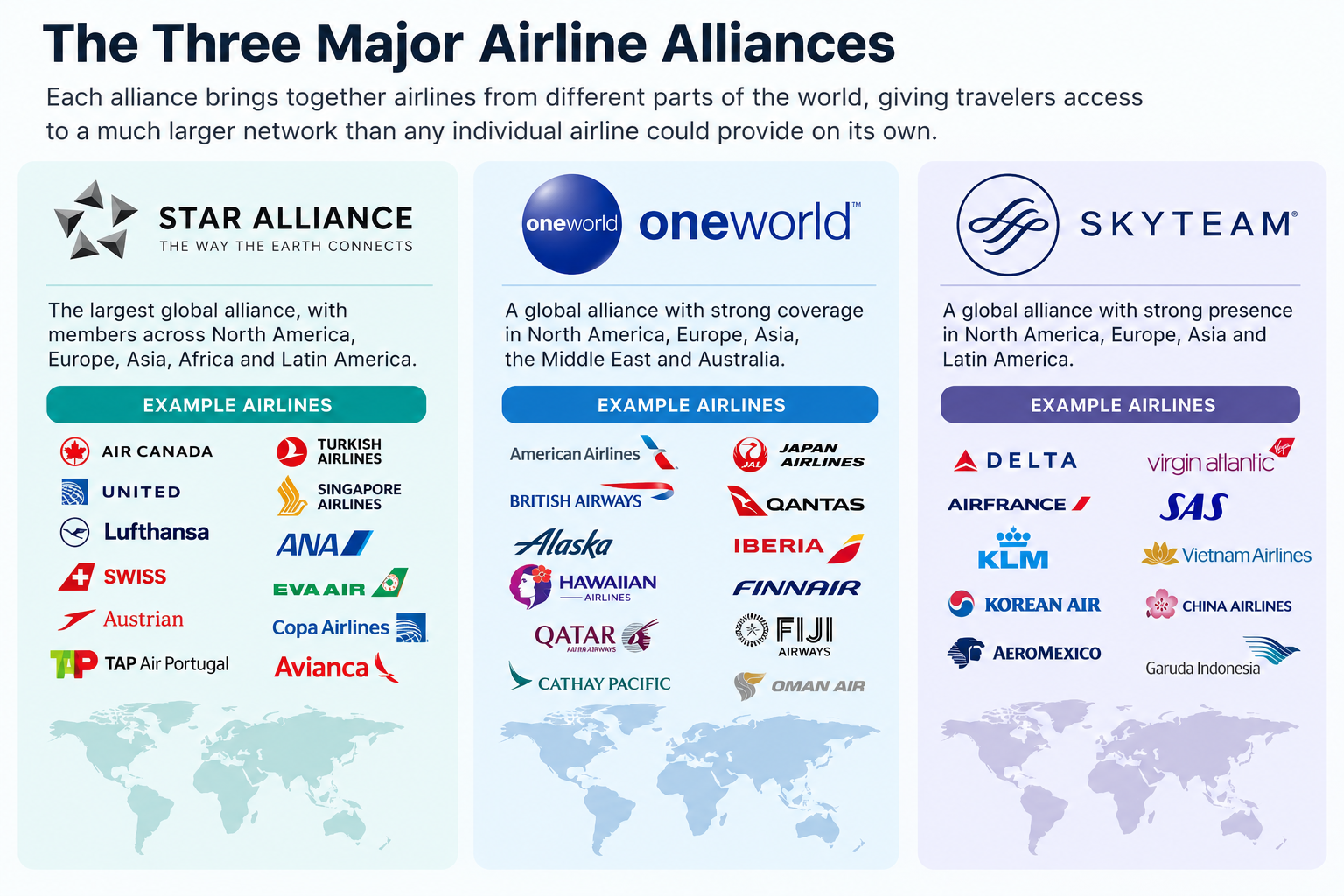
The important part isn’t memorizing every airline. It’s recognizing that one loyalty program can potentially give you access to a much larger network of partner airlines.
Star Alliance
Star Alliance connects airlines across North America, Europe, Asia, Africa, Latin America and the Pacific. Some of the names travelers may recognize include Air Canada, United Airlines, Lufthansa, SWISS, Austrian Airlines, TAP Air Portugal, Turkish Airlines, Singapore Airlines, ANA, EVA Air, Copa Airlines, Avianca, Air New Zealand, Ethiopian Airlines and ITA Airways.
For us, this is where a program such as Aeroplan becomes much more interesting. Aeroplan may have Air Canada attached to its name, but its usefulness extends well beyond Air Canada flights because of the airline’s partner network.
Instead of simply asking, “Where does Air Canada fly?”, we can ask, “Where can our Aeroplan points take us using Air Canada and its partners?” That is a much more useful way to think about an airline loyalty program.
Why this matters
The value of a loyalty program is not just the airline whose name is attached to it. The partner airlines you can access through that program can be just as important.
oneworld
oneworld includes major airlines from several parts of the world, including American Airlines, British Airways, Alaska Airlines, Hawaiian Airlines, Qatar Airways, Cathay Pacific, Japan Airlines, Qantas, Iberia, Finnair, Fiji Airways and Oman Air.
Hawaiian Airlines joined oneworld in 2026 as part of its integration with Alaska Airlines. This is a good example of why alliance membership is worth paying attention to: airline networks and partnerships continue to evolve.
oneworld also becomes particularly interesting when you start learning about Avios. Several loyalty programs use Avios, including British Airways Club, Iberia Club, Qatar Airways Privilege Club and Finnair Plus. Eligible members can transfer Avios between a number of these linked programs, adding another layer of flexibility beyond the alliance itself.
We will cover Avios and these types of partnerships separately because they deserve their own explanation. For now, the important point is that an alliance is only one part of the points and miles picture.
SkyTeam
SkyTeam is the third major global airline alliance and includes airlines such as Delta Air Lines, Air France, KLM, Korean Air, Aeromexico, SAS, Virgin Atlantic, Vietnam Airlines and China Airlines.
One loyalty program many travelers will come across within this alliance is Flying Blue, the program associated with Air France and KLM. But just as with Aeroplan, the important part is not simply the airlines named on the program. Flying Blue also provides access to eligible partner flights.
This is the pattern we want you to recognize: the airline on the loyalty account is only the starting point. The network behind it is what can make the program much more useful.
You Don’t Need an Account With Every Airline
Seeing all of these airlines can make points and miles seem more complicated than they need to be. It is easy to assume that if you might eventually fly 20 different airlines, you need 20 different loyalty accounts.
You don’t. A better approach is to understand which loyalty programs give you useful access to the networks and airlines you are most likely to use.
| Loyalty Program | Network Access |
|---|---|
| Aeroplan | Star Alliance plus additional airline partners |
| United MileagePlus | Star Alliance plus additional airline partners |
| American AAdvantage | oneworld plus additional airline partners |
| British Airways Club | oneworld plus additional airline partners and the Avios ecosystem |
| Flying Blue | SkyTeam plus additional airline partners |
This is why we think understanding the alliances should come before deciding which airline loyalty accounts to open. Once you understand the networks, the individual programs start to make much more sense.
The Same Flight Can Cost Different Amounts of Points or Miles
There is another important part of the strategy. Just because several loyalty programs can access the same airline does not mean those programs will charge the same amount of points or miles to book the same flight.
The amount required can differ, and so can taxes, carrier-imposed charges, cancellation policies, change rules and award availability. That means the airline operating your flight and the loyalty program you use to book it can be two completely different things.
⭐ Strategic Tip
Think of points and miles as different currencies. Several currencies may be able to book the same flight, but the price and rules can be very different.
A Simple Example
Imagine you find a flight operated by Lufthansa. Lufthansa is a Star Alliance airline, but that does not necessarily mean you need Lufthansa Miles & More miles to book the flight.
Depending on award availability and each program’s rules, an eligible Lufthansa award seat may also be bookable through another Star Alliance loyalty program, such as Aeroplan or United MileagePlus. You would still be flying on a Lufthansa airplane, but the points or miles used to book the seat could come from a different airline’s loyalty program.
This distinction is one of the foundations of using points and miles strategically. The goal is not simply to collect points or miles with the airline you want to fly. It is to understand which loyalty program gives you a useful way to access that flight.
Airline Alliances Aren’t the Whole Story
The three alliances are the easiest place to start, but they are not the entire system. Airlines can also build individual partnerships outside their alliance, and some useful airline relationships cross alliance boundaries completely.
The Avios ecosystem is one example. British Airways Club members can transfer Avios between several participating loyalty programs when the accounts are eligible and linked, including programs such as Iberia Club, Qatar Airways Privilege Club and Finnair Plus.
These relationships can create opportunities that are not obvious if you look only at Star Alliance, oneworld and SkyTeam. That is why our next article will focus specifically on airline partnerships outside the major alliances and how systems such as Avios fit into the bigger picture.
How We Think About Airline Alliances
We don’t start by trying to memorize every airline and every loyalty program. We start with the network. Which alliance does the airline belong to? Which loyalty programs can access that airline? Are there useful partners outside the alliance?
That approach gives us a framework instead of a long list of programs to remember. Once we understand the network, we can compare the programs within it and decide which ones are actually useful for the way we travel.
When Airline Alliances Matter Most
Alliances become especially useful when your travel is international or when one airline cannot get you all the way to your destination. A loyalty program that gives you access to several partner airlines can create far more options than a program you think of only in terms of its home airline.
They are also important when searching for award flights. If one airline does not have the route or availability you need, an alliance partner may. Understanding that relationship gives you more places to look instead of assuming there are no options.
When the Alliance Matters Less
An alliance should not automatically determine which loyalty program you use. Sometimes a non-alliance partnership offers a better option, and sometimes the points or miles required, taxes or fees through one program make another program more attractive.
The alliance is therefore a starting point, not the entire strategy. It helps you understand which airlines are connected, but you still need to look at the individual loyalty program before transferring or spending points and miles.
Our Take
When we first started looking at airline loyalty programs, seeing dozens of airlines and different points and miles currencies made the whole system seem more complicated than it actually was. Understanding the alliances simplified it.
We’ve also used these relationships ourselves. We flew Singapore Airlines using Aeroplan points, Qatar Airways using Avios, and SAS using Flying Blue points. We weren’t limited to earning a loyalty currency directly with the airline we wanted to fly. We were able to use another program within the broader network to book those flights.
Those experiences made the value of airline alliances much more obvious to us. Instead of trying to learn every airline individually, we started by looking at the larger networks: Star Alliance, oneworld and SkyTeam. From there, we can look at the loyalty programs and partnerships that give us access to those networks.
That doesn’t remove every bit of complexity from points and miles, but it gives us a logical place to start. Once you understand the structure, choosing which airline loyalty accounts are actually worth opening becomes much easier.
The Bottom Line
You don’t need points or miles with every airline. What matters is having access to the right networks and understanding how the loyalty programs within those networks work.
Star Alliance, oneworld and SkyTeam provide the foundation. From there, airline partnerships outside the alliances — including the Avios ecosystem — add another layer of flexibility. That is what we’ll look at next before getting into which airline loyalty accounts we think are worth opening.
Not Sure What Strategy Fits Your Life?
There is no single points and miles strategy that works for everyone. The right approach depends on where you live, how you travel and what you want your points and miles to help you accomplish.
If you’re trying to figure out what makes sense for your situation, learn more about how we can help you think through your next move.
Pingback: Airline Partnerships Beyond the Major Alliances – Strategic Early Retirement